
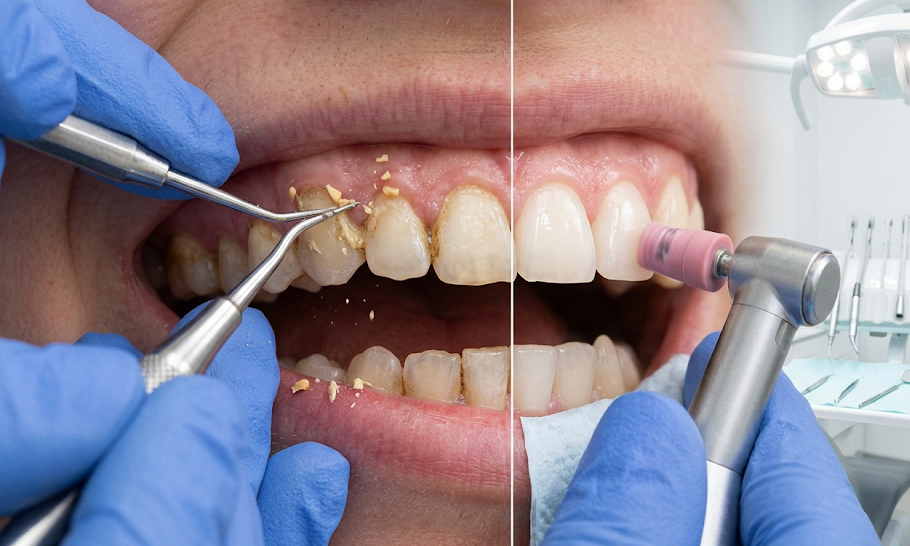
What Is the Difference Between Scaling and Polishing?
There is more to having healthy teeth and gums than brushing twice a day. Brushing your teeth and flossing every day allows for the removal of plaque from your mouth. However, plaque can be deposited in places that are not easily reached using a toothbrush. As such, plaque accumulates and may become hardened to form tartar, causing gum inflammation and other oral problems.
Dental cleaning will assist in removing such deposits as well as keeping your mouth healthy. Two common procedures are scaling and polishing of teeth. These procedures may be done at the same session; however, their purposes are different.
What Is Dental Scaling?
Dental Scaling is an oral hygiene process that involves the removal of the accumulation of plaque and tartar, otherwise called calculus, from the surface of the teeth and along the gum line.
The plaque is a film of bacteria that is produced naturally by the teeth. It is easily removed by regular brushing and flossing. But if plaque is not removed, it can be calcified by the minerals in the saliva and turn into tartar.
Unlike plaque which is soft, tartar cannot be easily cleaned with the toothbrush and dental floss.
Why Is Dental Scaling Important?
It offers a place where more plaque can attach itself. When this happens, it becomes an area that causes gingival irritation and periodontitis.
Professional scaling helps to:
- Remove hardened tartar from tooth surfaces.
- Clean areas around the gumline.
- Reduce plaque and bacterial deposits.
- Support healthier gums.
- Help manage early signs of gum disease.
- Reach areas that are difficult to clean with everyday brushing.
The dental hygienist will use the ultrasonic scaler or hand instruments or even both depending on where and how much deposits there are.
What Is Dental Polishing?
Dental polishing is one kind of process that assists in eliminating some external stains on the surface of your teeth. This process usually takes place after scaling.
In conventional polishing, a dentist uses a miniature spinning rubber cup along with a good dental polishing paste to clean and smoothen the teeth surface affected by staining from common food and beverages.
Polishing your teeth makes them feel smooth and look better. Yet, it does not reduce the amount of plaque build-up in the mouth nor changes the color of your teeth.
Benefits of Dental Polishing
Professional polishing may help to:
- Remove certain surface stains.
- Smooth the surfaces of teeth.
- Remove remaining soft deposits.
- Improve the appearance of externally stained teeth.
- Leave your teeth feeling cleaner.
The amount of staining removed depends on its cause and severity. Stains within the tooth structure may require a different treatment.
Scaling vs Polishing: What Is the Main Difference?
Polishing and scaling are normally carried out concurrently, although they are different procedures. Scaling involves getting rid of plaque and tartar, while polishing deals with the surfaces.
| Comparison | Dental Scaling | Dental Polishing |
| Main purpose | Removes plaque and hardened tartar | Removes certain external stains |
| Main target | Deposits on teeth and around the gumline | Surface discolouration and remaining soft deposits |
| Equipment | Ultrasonic scaler and hand instruments | Polishing cup, brush and paste |
| Main benefit | Supports gum health | Improves surface cleanliness and smoothness |
| Usual order | Performed first | Often performed after scaling |
In simple terms, scaling cleans away hardened deposits, while polishing helps improve the finish of the tooth surfaces.
What Is the Difference Between Scaling, Polishing and Airflow Cleaning?
Airflow cleaning is yet another technique of professional dental hygiene care. This method makes use of a mixture of compressed air, water and powder aimed at eliminating the dental biofilm and some external dental stain.
Unlike polishing that employs the use of spinning cup with polish, Airflow produces a fine spray on the tooth.
The method could be ideal for cleaning below the gum line and other inaccessible parts. Airflow cleaning technique does not have to remove tartar necessarily. The tools used for scaling could still be required for removing calculus when it is present.
The cleaning technique you may need depends on various factors, including your oral hygiene.
Read more about professional Airflow dental hygiene treatment to understand how this cleaning technique works.
Does Scaling and Polishing Hurt?
For most people, scaling and polishing are quite comfortable treatments. Nevertheless, there may be some transient sensitivity or slight discomfort.
Your experience may depend on:
- The amount of tartar present.
- Whether your gums are inflamed.
- Existing tooth sensitivity.
- The location of the deposits.
- Your overall gum health.
In scaling, you might experience vibrations, pressure or water spray. In case your gums are sensitive, you will feel some tenderness during the cleaning procedure.
The polishing process is usually not painful, but some patients may have temporary sensitivity after it.
In case you feel any discomfort, inform your dentist about it. They can change the cleaning method if necessary.
If you have never had a professional cleaning appointment before, find out what to expect during your first dental hygiene appointment.
How Often Should You Have Scaling and Polishing?
There is no fixed timeframe that suits everyone. The regularity of professional cleaning depends on how healthy your oral cavity is and how fast plaque and tartar form.
For some individuals, hygiene sessions should be done every three to six months, whereas for others, they may not be required as frequently. Individuals having gum disease may need a more individualised plan for their dental care.
Factors that influence cleaning frequency include:
- How quickly tartar builds up.
- Your brushing and flossing habits.
- The condition of your gums.
- Smoking or tobacco use.
- Previous gum disease.
- Dental appliances, implants or other oral health considerations.
Your dentist or dental hygienist can recommend an appropriate schedule after examining your teeth and gums.
Regular dental examinations are also important because they help identify potential problems before they become more serious.
What Happens During a Scaling and Polishing Appointment?
Dental cleaning visits are typically performed after first doing an assessment of what is required for your dental health.
Step 1: Examination of Your Teeth and Gums
The teeth and gums are examined to look for any plaque, tartar, staining, or inflammation.
Step 2: Removal of Plaque and Tartar
Plaque and tartar are scraped from the surface of the teeth and below the gum line using scaling tools, which depend on where the tartar has built up.
Step 3: Polishing the Teeth
In situations where it is necessary, teeth polishing can be performed to polish out some stains.
Step 4: Personalised Oral Hygiene Advice
Advice on oral hygiene, such as brushing techniques and flossing, might be given.
These procedures can vary each time you visit the dentist’s office. Depending on whether you have large amounts of tartar build-up or gum disease, you might be prescribed another kind of treatment.
How to Maintain Your Teeth After Professional Cleaning
Professional teeth cleaning removes deposits, which may be hard to control at home; however, it is essential to maintain daily care to prevent the formation of plaque again.
Here are some simple habits to follow:
1. Brush Your Teeth Twice Daily
Brush for about 2 minutes twice per day using toothpaste containing fluoride. Focus on brushing gumlines and rear surfaces of your teeth.
2. Clean Between Your Teeth Every Day
Clean the parts between teeth with dental floss or interdental brushes, where regular brushes cannot reach.
3. Reduce Frequent Sugary Snacks and Drinks
Intake of sugar more often may cause cavities. Limit yourself to having fewer snacks containing sugars.
4. Avoid Smoking and Tobacco
It may not only affect the coloration of your teeth but also cause periodontitis. Therefore, it would be better to refrain from smoking.
5. Attend Regular Dental Check-Ups
This will help you monitor the status of your teeth and gums and detect some problems with them.
Is Scaling and Polishing the Same as Teeth Whitening?
No. Scaling, polishing and teeth whitening are different procedures.
- Scaling: Removes plaque and hardened tartar from the teeth.
- Polishing: Helps remove certain external stains and smooths tooth surfaces.
- Teeth whitening: Uses whitening agents to lighten the natural shade of teeth.
Your teeth may look brighter after a professional cleaning because surface deposits and stains have been removed. However, scaling and polishing do not bleach the natural tooth structure.
If your main concern is tooth colour, you can learn more about professional teeth whitening treatment.
Can You Eat Immediately After Scaling and Polishing?
It is normal for most people to be able to eat following scaling and polishing. But your teeth and gums might be a little bit sensitive temporarily.
In case you are feeling sensitive, try to avoid eating very hot, cold or acidic food and beverages until your sensitivity improves.
If you have undergone further treatment, such as the application of fluoride, follow the post-treatment advice provided by your dentist.
Conclusion
Scaling and polishing are two separate yet complimentary services provided in dental hygiene. The former involves the removal of plaque and calcified tartar that cannot be removed by brushing alone, whereas the latter assists in removing some surface stains.
Both processes can assist in maintaining good oral hygiene alongside regular brushing and cleaning of the interdental spaces and regular dental visits.
The frequency and nature of the professional cleaning needed will depend on the state of one’s dental hygiene. This can be determined by a dentist or a dental hygienist.
Frequently Asked Questions
1. What is the main difference between scaling and polishing?
Scaling is done for removing plaque and the buildup of tartar from the teeth and along the gum lines. Polishing is done to remove the external discoloration from the teeth.
2. Does scaling remove yellow stains from teeth?
Though the process of scaling helps in removal of the yellow discoloration on the teeth, it does not bleach the teeth and leaves them as it is.
3. Can polishing remove tartar?
No. Polishing is a technique used to remove stains only and not the tartar build up.
4. Is dental scaling safe for enamel?
The dental scaling done properly by the professionals will not cause any damage to your enamel.
5. How long does scaling and polishing take?
The time period for scaling and polishing of teeth varies according to the quantity of plaque and tartar formation.
6. How often should I get my teeth scaled and polished?
It depends upon you individually as each person is different.
7. Can I brush my teeth after scaling and polishing?
In most cases, it is possible to maintain your regular brushing regimen. If your gums are sensitive, use a soft-bristled toothbrush.
8. Does polishing make teeth permanently whiter?
No. Polishing removes some external discolorations but will not permanently whiten teeth.
